

 |
CCAI9021 Artificial Intelligence
|
Course Description
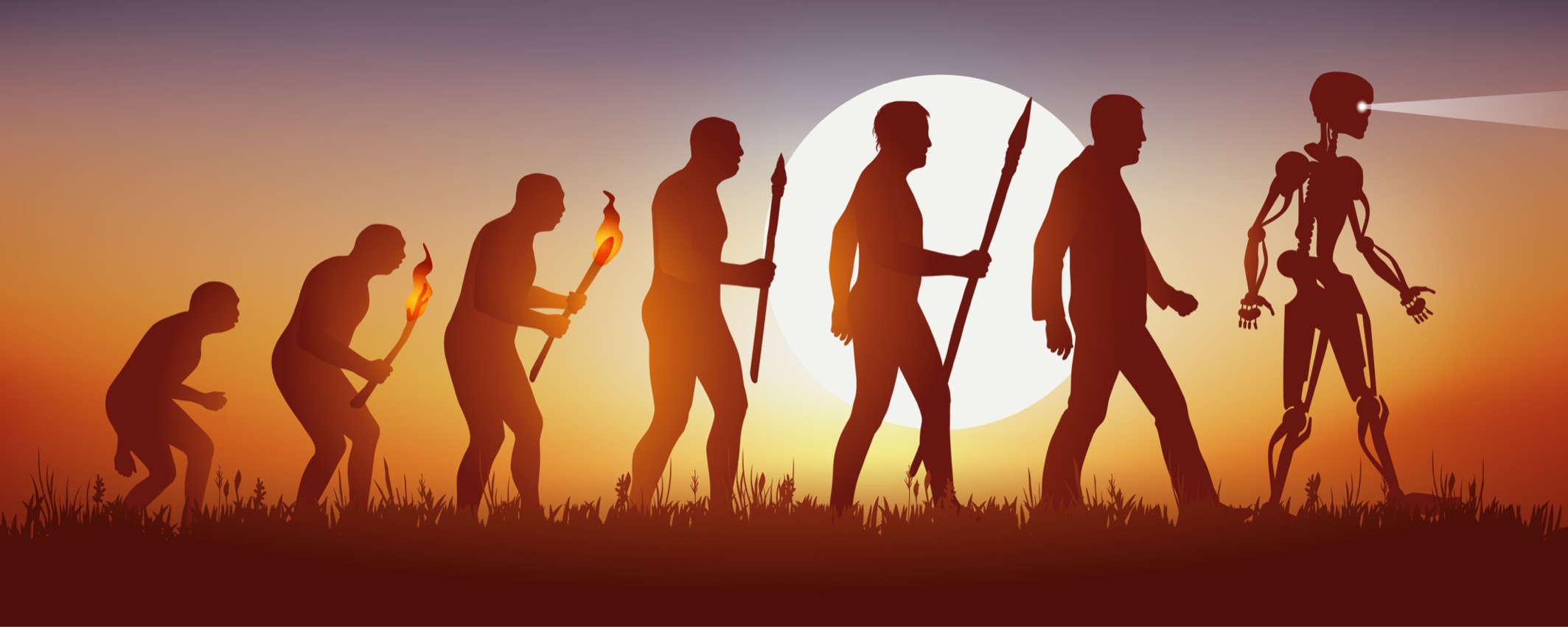
Cinema has long explored the profound convergence of biology and biotechnology, from creating cyborgs of organic and inorganic parts, to cloning and genetic engineering, and to immortality through technology. But what once felt like pure science fiction is starting to feel strangely possible. Is this becoming a reality with artificial intelligence (AI) in human evolution, charting a transformative trajectory from our origins to the dawn of “Human 2.0.”?
This course takes you on an exciting journey into how technology and biology are coming together to change what it means to be human. We’ll start by looking at how life and intelligence have evolved over time, from early humans to the modern world. You’ll see how humans gained dominance, and how science and the internet have reshaped the way we live and think. Now with advances in biology and AI, we are entering an era where machines can think, learn, and maybe even help us upload our minds into computers.
We will explore how AI is not just changing science, but also the way society works, much like how the Industrial Revolution transformed the world. With these powerful technologies come big questions: Should we trust AI with critical decisions? Could we create forms of artificial life? And what happens to human agency as machines grow more capable? This course challenges you to reflect: are we becoming enhanced, almost “superhuman” or are we risking losing control to the very systems we create?
Throughout this course, you will tap into the class’s collective creativity through collaborative, forward-thinking projects. Expect dynamic, immersive learning from AI-powered platforms and gamified challenges to hands-on role-playing that put you at the centre of the future. You will tackle big questions: are we shaping AI, or is it shaping us? This is more than a science class, it is about envisioning the future and shaping the kind of world we want to build with the breakthroughs of today and tomorrow.
Course Learning Outcomes
On completing the course, students will be able to:
- Evaluate human evolution and cognitive development.
- Recognize how science and technology shaped human civilization.
- Differentiate data, information, and scientific truth.
- Conceptualize the circle of knowledge and AI.
- Evaluate societal implications at the intersection of AI and artificial life.
Offer Semester and Day of Teaching
First semester (Wed)
Study Load
| Activities | Number of hours |
| Lectures | 24 |
| Tutorials | 8 |
| Reading / Self-study | 60 |
| Assessment: Project assignments | 30 |
| Assessment: In-class assessments | 2 |
| Total: | 124 |
Assessment: 100% coursework
| Assessment Tasks | Weighting |
| Group project and presentation | 20 |
| Video report | 30 |
| Tutorial exercises | 30 |
| In-class assessment | 20 |
Required Reading
Articles:
- Barros, M. T., Kagan, B. J., Hartung, T., & Smirnova, L. (2025). Editorial: Intersection between the biological and digital: synthetic biological intelligence and organoid intelligence. Frontiers in Cellular Neuroscience, 18, 1542629. From https://doi.org/10.3389/fncel.2024.1542629
- European Commission, Directorate-General for Research and Innovation. (2024). Living guidelines on the responsible use of generative AI in research. From https://research-and-innovation.ec.europa.eu/document/download/2b6cf7e5-36ac-41cb-aab5-0d32050143dc_en?filename=ec_rtd_ai-guidelines.pdf
- Madanchian, M., & Taherdoost, H. (2025). The impact of artificial intelligence on research efficiency. Results in Engineering, 26, 104743. From https://doi.org/10.1016/j.rineng.2025.104743
- Office of the Privacy Commissioner for Personal Data, Hong Kong. (2021). Guidance on the ethical development and use of artificial intelligence. From https://www.pcpd.org.hk/english/resources_centre/publications/files/guidance_ethical_e.pdf
- Royal Society. (2023). Science in the age of AI: how artificial intelligence is changing the nature and method of scientific research. From https://royalsociety.org/-/media/policy/projects/science-in-the-age-of-ai/science-in-the-age-of-ai-report.pdf
- Siegel, D. J. (2012). The developing mind: how relationships and the brain interact to shape who we are (2nd ed.). New York: Guilford Press. [Chap. 7 “Self-regulation”; Chap. 8 “Interpersonal connection”]
- Weigel, A., Caldas, C., Meyer, A., & Morris, S. A. (2022). The impact of AI on research. Cell, 185(15), 2621–2622. From https://doi.org/10.1016/j.cell.2022.06.024
Videos:
- 60 Minutes. (2023). “Godfather of AI” Geoffrey Hinton: The 60 Minutes Interview. From https://www.youtube.com/watch?v=qrvK_KuIeJk
- Four Minute Books. (2022). Sapiens Summary (Animated) — The Definitive History of Humankind & How Humans Became the #1 Species. From https://www.youtube.com/watch?v=HitVj45O5hI
- Paul G. Allen School. (2024). What we see and what we value: AI with a human perspective—Fei-Fei Li (Stanford University). From https://www.youtube.com/watch?v=gzOwpEupP5w&t=1414s
- TED. (2024). With Spatial Intelligence, AI Will Understand the Real World | Fei-Fei Li | TED. From https://www.youtube.com/watch?v=y8NtMZ7VGmU
- Vector Institute. (2024). Geoff Hinton – Will Digital Intelligence Replace Biological Intelligence? | Vector’s Remarkable 2024. From https://www.youtube.com/watch?v=Es6yuMlyfPw
- World Science Festival. (2024). Will AI Spark the Next Scientific Revolution? From https://www.youtube.com/watch?v=7wznuB0sKlw&t=202s
Course Co-ordinator and Teacher(s)
| Course Co-ordinator | Contact |
| Professor W.C.W. Chan School of Biomedical Engineering, Li Ka Shing Faculty of Medicine |
Tel: 3917 3274 Email: cwilson@hku.hk |
| Teacher(s) | Contact |
| Dr W.C.W. Chan School of Biomedical Engineering, Li Ka Shing Faculty of Medicine |
Tel: 3917 3274 Email: cwilson@hku.hk |
| Professor D. Chan School of Biomedical Sciences, Li Ka Shing Faculty of Medicine |
Tel: 3917 9482 Email: chand@hku.hk |
| Dr M.L. Khong School of Clinical Medicine, LKS Faculty of Medicine |
Tel: 3917 9788 Email: khongml@hku.hk |