

 |
CCCH9068 China: Culture, State and Society
|


Course Description
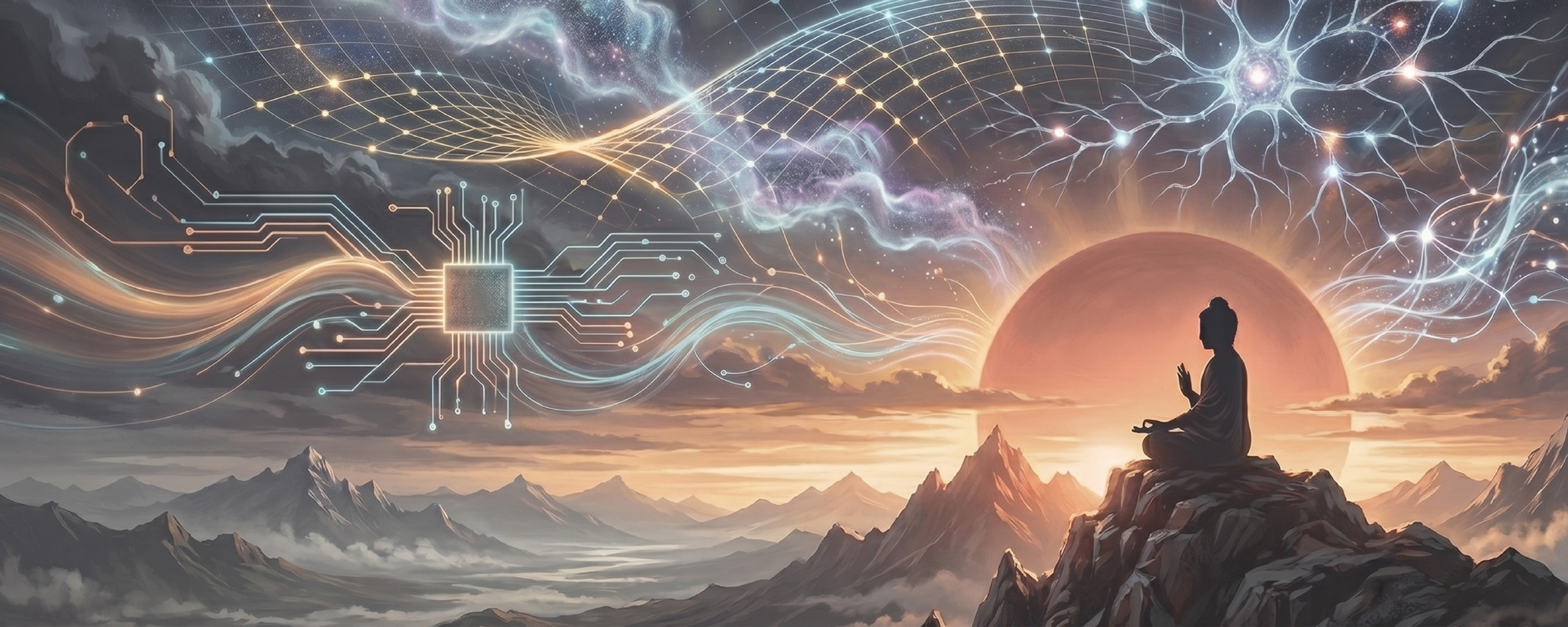
This course invites you to explore one of the most fascinating questions of our time: what is reality, and how do we know it? Bringing Chinese Buddhist philosophy into conversation with modern science, we look at how different traditions understand consciousness, the relationship between mind and matter, and what this means for how we experience and make sense of the world. Focusing on major Chinese Buddhist schools such as Weishi, Sanlun, Tiantai, and Huayan, you will encounter influential ideas like emptiness, dependent arising, and radical interconnectedness, originally developed in Indian Buddhism and transmitted in the Chinese context. These are then brought into dialogue with contemporary debates in quantum physics, relativity, neuroscience, cognitive science, and artificial intelligence. Topics include the “hard problem” of consciousness, interpretations of quantum mechanics, meditation and the brain, and whether AI can simulate intelligence without possessing a self. Through lectures, tutorials, and a guest lecture on Buddhism and AI, you will learn to compare different models of reality and think through their philosophical, scientific, and ethical implications. We will be doing philosophy, but no prior background in Buddhism or science is required—only curiosity and a willingness to think deeply about the world and our place within it. At the end of the semester, after the exam period, we will visit a Chan Buddhist monastery for a hands on experience of meditative life in a beautiful natural setting.
Course Learning Outcomes
On completing the course, students will be able to:
- Demonstrate an understanding of the dialogue between Chinese Buddhism and science through a critical assessment of the relevant theoretical frameworks.
- Discuss relevant models of reality at the crossroads of East and West.
- Assess the possible challenges in interactions between Buddhists and scientists in the light of their worldviews and social contexts.
- Draw on primary and secondary source materials about the dialogue between Buddhism and science.
Offer Semester and Day of Teaching
First semester (Wed)
Study Load
| Activities | Number of hours |
| Lectures | 24 |
| Tutorials (i.e. small group face-to-face discussions) | 10 |
| Reading / Self-study | 36 |
| Assessment: Essay / Report writing | 30 |
| Assessment: Presentation (incl preparation) | 30 |
| Assessment: In-class quizzes | 4 |
| Total: | 134 |
Assessment: 100% coursework
| Assessment Tasks | Weighting |
| Class participation | 10 |
| Group presentation | 20 |
| In-class quizzes | 40 |
| Final Paper | 30 |
Required Reading
Week 1
- Becker, A. (2018). What Is Real? The Unfinished Quest for the Meaning of Quantum Physics. New York: Basic Books. [Introduction (pp. 1-8)]
- Schwartz, B. I. (1988). Introduction. Philosophy East and West, 38(4), 1-15.
Week 2
- Wallace, B. A. (2000). The Taboo of Subjectivity. Oxford, Oxford University Press. [pp. 123–139]
- Wilber, K. E. (1988). The Essential. Boston & London: Shambhala Publications. [pp. 108–114]
Week 3
- Cook, F. (Tran.) (1999). The Thirty Verses on Consciousness Only by Vasubandhu. (Translated from the Chinese of Hsuan-tsang.) Tokyo: Numata Center for Buddhist Translation and Research. [pp. 233-240]
- Mathes, K. -D. (2013). Reality in Buddhism. Encyclopedia of Sciences and Religion. Dordrecht: Springer. [pp. 1958–1965]
Week 4
- Adam, F., Gleiser, M., & Thompson, E. (2024). The Blind Spot. Cambridge: The MIT Press. [pp. 55–64]
- Westerhoff, J. (2018). The Golden Age of Indian Philosophy. Oxford: Oxford University Press. [pp. 107-112]
- Yü, C. -F. (2020). Chinese Buddhism. Hawai’i: University of Hawai’i Press. [pp. 144-148]
Week 5
- Smetham, G. P. (2011). The Quantum Illusion-like Nature of ‘Reality’ & the Buddhist Doctrine of ‘Two Levels of Reality’. Scientific GOD Journal, 2(6), 582–590.
- Walleczek, J., & Froessing, G. (2016). Is the World Local or Nonlocal? Towards an Emergent Quantum Mechanics in the 21st Century. Journal of Physics. Conference Series, 701, 1-7. From http://arxiv.org/pdf/1603.02862v1.pdf
Week 6
- Atmanspacher, H. (2014). 20th Century Variants of Dual-Aspect Thinking. Mind & Matter, 12(2), 251-259.
Week 7
- Sheldrake, R. (2009). A New Science of Life: The Hypothesis of Morphic Resonance (3rd ed.) London: Icon Books. [Appendices A & B]
Week 8
- Cleary, T. (Tran.) (1993). The Flower Ornament Scripture: A Translation of the Avatamsaka Sutra. Boulder, CO: Shambhala Publications. [pp. 215-219]
- Dechamps, M. (2019). Mind-Matter Interactions and Their Reproducibility. PhD thesis, Univ. of Munich. [Introduction (pp. 1-15)]
Week 9
- Mathes, K. -D. (2018). Liberation through Realizing the Emptiness of Dependent Arising: A Modern Interpretation of the Buddhist ‘Beyond’ in the Light of Quantum Physics. In G. Melville & C. Ruta (Eds.), Experiencing the Beyond: Intercultural Approaches. Challenges of Life: Essays on Philosophical and Cultural Anthropology 4. Berlin/Boston: Walter de Gruyter GmbH. [pp.198-211]
Week 10
- Doctor, T., et al. (2022). Biology, Buddhism, and AI: Care as the Driver of Intelligence. Entropy. From https://doi.org/10.3390/e24050710 [Introduction]
- Lusthaus, D. (2017). Vasubandhu, Xuanzang and the problem of consciousness. In S. Leach & J. Tartaglia (Ed.), Consciousness and the Great Philosophers (pp. 28-36). London: Routledge.
Week 11
- Begley, S. (2007). Train your Mind, Change your Brain. New York: Ballantine Books. [Chap. 6]
Videos:
- Benson, H. The Relaxation Revolution: Enhancing Health Through Mind-Body Healing. From https://www.youtube.com/watch?v=KZ7JfC3_Zgc
- Mingyur Rinpoche and Neural Synchrony in Meditation. From https://www.youtube.com/watch?v=5C_GOUvNZtk
- Tong, D. The Real Building Blocks of the Universe. From https://www.youtube.com/watch?v=zNVQfWC_evg
Course Co-ordinator and Teacher(s)
| Course Co-ordinator | Contact |
| Professor K.K.Mathes Centre of Buddhist Studies, Faculty of Arts |
Tel: 3910 2458 Email: kdmathes@hku.hk |
| Teacher(s) | Contact |
| Professor K.K.Mathes Centre of Buddhist Studies, Faculty of Arts |
Tel: 3910 2458 Email: kdmathes@hku.hk |