

 |
CCCH9069 China: Culture, State and SocietyChinese Civilization through Material Culture
|
Course Description
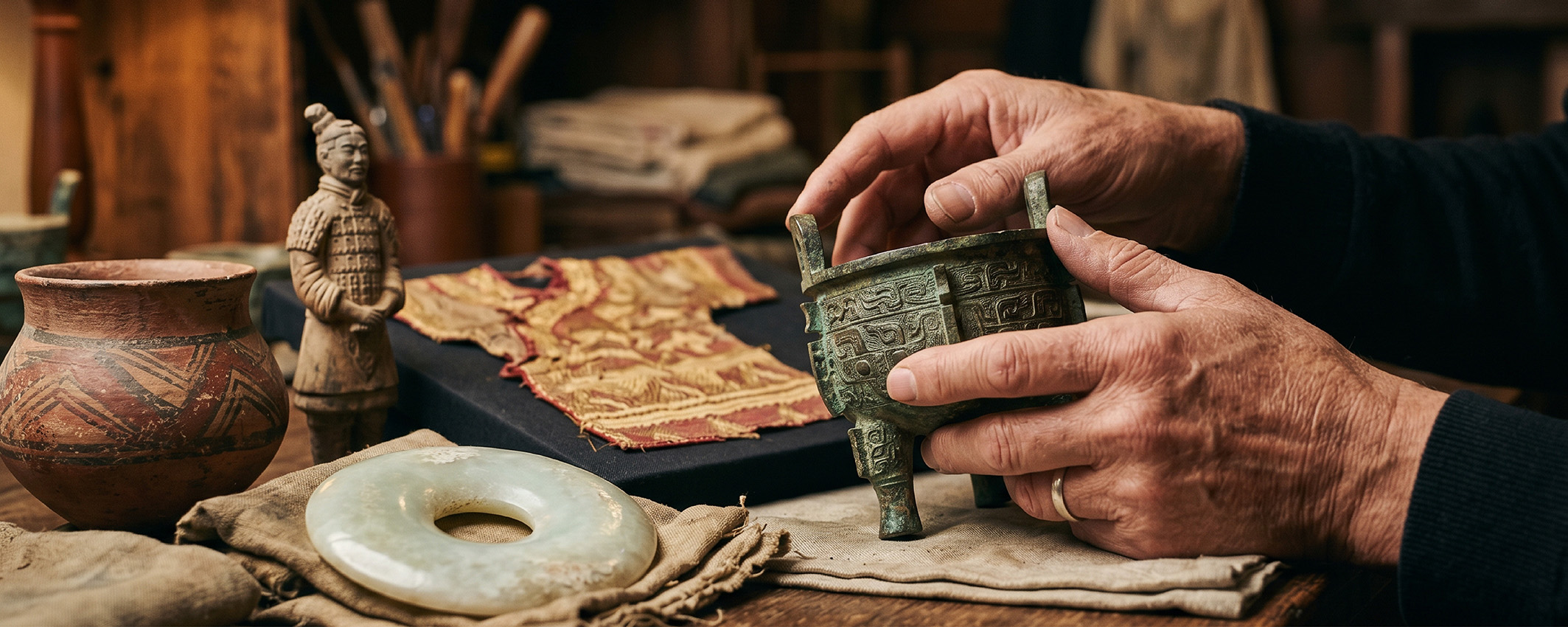
This hands-on course invites students to discover the fascinating origins of Chinese civilization (Prehistoric to the Han dynasty) by exploring the dynamic crossroads of culture, technology, art, and archaeology. History will be experienced up close through exclusive object-based learning – Instead of just reading about the past, students will handle ancient artifacts including oracle bones, inscribed bronzes, potteries, and wooden tablet in the collection of the University Museum and Art Gallery (UMAG), HKU.
This course will also take learning outside the classroom with exciting fieldtrips to major museums across Hong Kong (e.g. Heritage Museum, AMO) and the Greater Bay Area (e.g. Guangdong Provincial Museum, Zhongshan Municipal Museum). Together, students will be introduced to the archaeological and documentary evidence for the rise of early cities, the invention of writing, and groundbreaking material innovations.
Bridging the ancient and the modern, students will also discover how cutting-edge AI technologies are revolutionizing today’s study of Chinese archaeology, technology, and art history. Designed for students of all backgrounds, this highly interactive course will sharpen students’ analytical skills while providing a profound understanding of early China’s cultural and technological foundations and its lasting impact on the world.
[Object handling sessions at UMAG and other museum visits will be arranged during teaching weeks in the semester.]
Course Learning Outcomes
On completing the course, students will be able to:
- Analyse archaeological and textual evidence for the rise of Chinese civilization.
- Examine cultural, societal, and technological advances from the Neolithic to early imperial eras.
- Evaluate competing scholarly interpretations of civilization’s origins in China.
- Develop critical thinking and academic writing in the context of Chinese history.
- Engage on object-based-learning to train close observation and problem solving.
Offer Semester and Day of Teaching
Second semester (Wed)
Study Load
| Activities | Number of hours |
| Lectures | 24 |
| Tutorials (i.e. small group face-to-face discussions) | 8 |
| Seminars | 4 |
| Fieldwork / Visits | 55 |
| Assessment: Essay / Report writing | 20 |
| Assessment: Presentation (incl preparation) | 10 |
| Assessment: In-class test | 2 |
| Total: | 123 |
Assessment: 100% coursework
| Assessment Tasks | Weighting |
| Tutorial participation | 10 |
| Reading responses | 25 |
| Group presentation | 35 |
| Reflective writing | 30 |
Required Reading
- Allan, S., & Chang, K. C. (2005). The formation of Chinese civilization: an archaeological perspective. New Haven: Yale University Press.
- Barbieri-Low, A. (2007). Artisans in early imperial China. Washington: University of Washington Press.
- Bunker, E. C. (1993). Gold in the ancient Chinese world: a cultural puzzle. Artibus Asiae, 53, 27-50.
- Creel, H. G. (1937). The birth of China. New York: Frederick Ungar.
- Di Cosmo, N. To become a god: cosmology, sacrifice, and self-divinization in early China. Cambridge, Mass.: Harvard University Press, 2002. [Chap. 1 “Anthropomorphizing the Spirits: Sacrifice and Divination in Late Bronze Age China”; Conclusion “The Art of the Sacrifice”]
- Fong, W. et al. (eds.) (1980). The great Bronze Age of China: an exhibition from the People’s Republic of China. New York: Metropolitan Museum of Art.
- Graham, A. C. (1989). Disputers of the Tao: philosophical argument in ancient China. Chicago and La Salle, Illinois: Open Court.
- Keightley, D. N. & Noel, B. (eds.) (1983). The origins of Chinese civilization. Berkeley: University of California Press.
- Ledderose, L. (2000). Ten Thousand Things: Module and Mass Production in Chinese Art. Princeton: Princeton University Press.
- Liu, C. Y. (2016). ‘Concepts of architectural space in historical Chinese thought’, in Powers, M. J. & Tsiang, K. R. (eds.) A companion to Chinese Art. West Sussex: Wiley Blackwell, 195-211.
- Loewe, M. (2018). Chinese ideas of life and death: faith, myth and reason in Han China. London: Routledge.
- Needham, J. (1976). Science and civilisation in China vol. 5: chemistry and chemical technology. Cambridge: Cambridge University Press.
- Rawson, J. (2025). Life and afterlife in ancient China. London: Penguin.
- von Falkenhausen, L. (2006). Chinese society in the age of Confucius (1000-250 BC): the archaeological evidence. Los Angeles: Cotsen Institute of Archaeology, University of California, Los Angeles.
- Wu, H. (2010). The art of the Yellow Springs, understanding Chinese tombs. London: Reaktion.
Documentaries:
- “China before China” (何以中國), 2023
Course Co-ordinator and Teacher(s)
| Course Co-ordinator | Contact |
| Dr S. Wang University Museum and Art Gallery |
Tel: 3917 5515 Email: wshengyu@hku.hk |
| Teacher(s) | Contact |
| Dr S. Wang University Museum and Art Gallery |
Tel: 3917 5515 Email: wshengyu@hku.hk |
| Dr F. Knothe University Museum and Art Gallery |
Tel: 2241 5501 Email: fknothe@hku.hk |