

Events Calendar

- This event has passed.
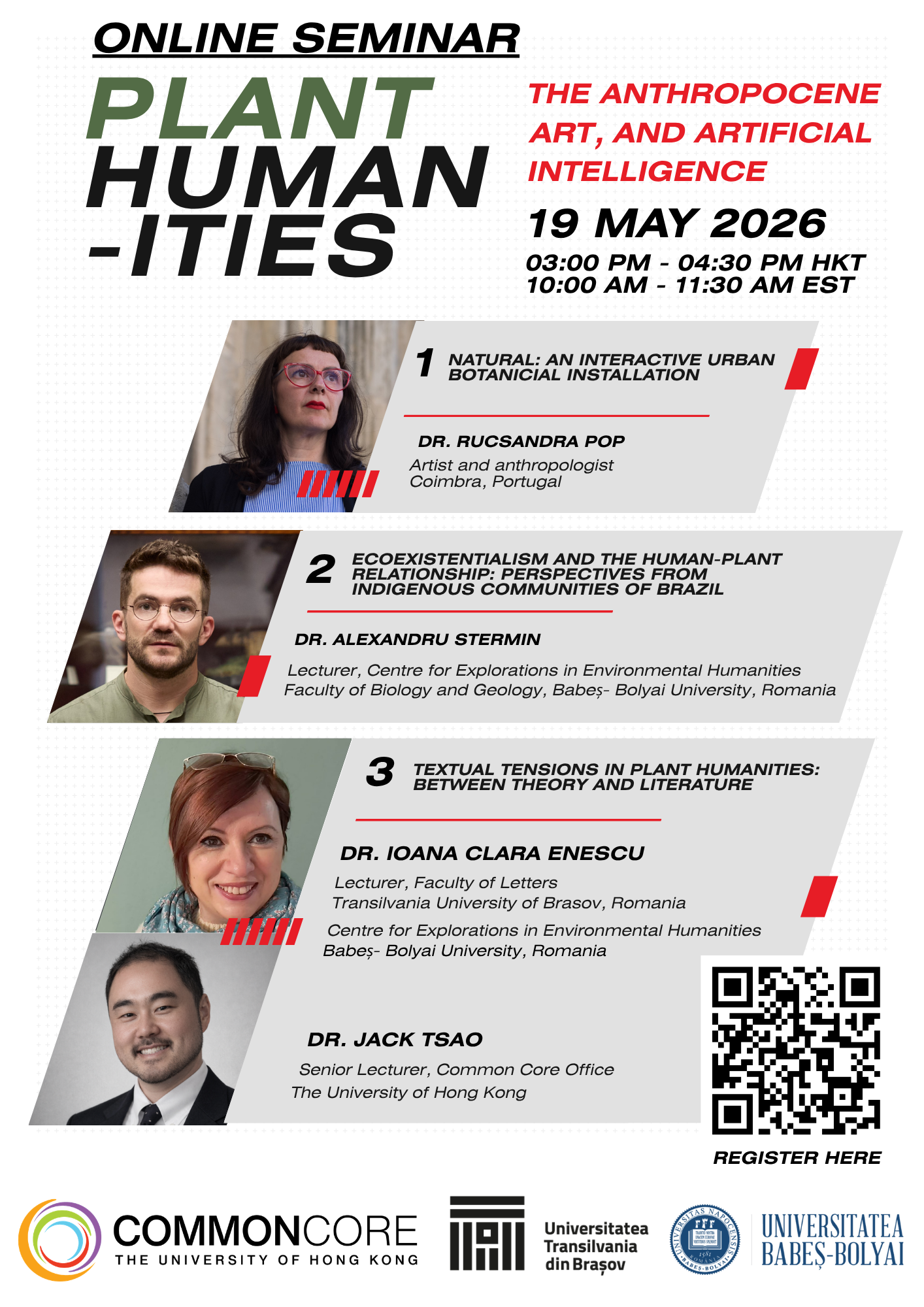
Seminar: Plant Humanities – The Anthropocene, Art, and Artificial Intelligence
19 May @ 3:00 pm - 4:30 pm
Seminar: Plant Humanities – The Anthropocene, Art, and Artificial Intelligence
Date: May 19, 2026 (Tue)
Time: 3:00 pm – 4:30 pm Hong Kong Time / 10:00 am – 11:30 am Eastern Standard Time
Venue: Online (Zoom)
If you are interested, please register at https://forms.office.com/r/Q7tnC5JQ3N
All are welcome.
The Zoom meeting link will be provided in the confirmation email.
Join this transdisciplinary conversation with an artist, a biologist-explorer, and a Sino-literary scholar as we discuss how human–plant relationships reshape community, meaning, and the future of the environmental humanities.
Natural: An interactive urban botanical installation
Dr. Rucsandra Pop, Artist and anthropologist, Coimbra, Portugal
Natural is an interactive urban botanical installation — an oasis of dialogue co-created with the community. Through 15 interviews with immigrants in Coimbra, the project identifies natural elements that made people coming from different countries feel “at home”, and adapt to the realities of their new city. The living plants and their stories of rooting will be integrated into a collective artwork. At its culmination, a Community Supper near the installation will facilitate dialogue between immigrants, students, and decision-makers, transforming the public space into a lasting “garden of memories” and a catalyst for a more cohesive Coimbra. The artist will present her creative process for Natural, linked to her previous work that investigates how nature can become a teacher for self-awareness and self-love. The project is included in the AnoZero’26 Convergent Programme — Sensory and Participatory Experiences.
Rucsandra Pop (b. 1976) is an artist and anthropologist recently relocated to Coimbra. She works at the intersections of disciplines and worlds, collaborating with practitioners across theatre, visual arts, contemporary dance, architecture, and the social sciences, driven by the belief that art should be accessible to everyone. Her practice explores how dialogue and creativity can transform cities, neighbourhoods, and villages into genuine communities, and how vulnerability — in speaking and especially in listening — makes living together possible. She views art as a creator of “pockets for vulnerability” and enjoys exploring these spaces with others. More on her website: https://www.rucsandrapop.com/about
Ecoexistentialism and the Human-Plant Relationship: Perspectives from Indigenous Communities of Brazil
Dr. Alexandru N. Stermin, Lecturer, Center for Explorations in Environmental Humanities, Faculty of Biology and Geology, Babeș- Bolyai University, Romania
This presentation introduces ecoexistentialism as an emerging philosophical framework that explores how fundamental existential questions — identity, wellbeing, freedom, love, death, and the meaning of existence — are metabolised in direct relationship with the natural world. Situated at the intersection of existentialist philosophy and ecology, ecoexistentialism proposes that a world composed exclusively of human relations may be insufficient for full human existence. Drawing on ethnographic fieldwork conducted between 2023 and 2026 among the Kalapalo and Umutina peoples of Brazil’s Xingu and Paraguay river basins, this presentation focuses specifically on human-plant relationships as sites of existential meaning-making. In animist and totemist ontologies, plants are not passive resources but relational subjects: origin ancestors, cosmological agents, and partners in love, identity, and moral life. The presentation argues that attending to indigenous plant relationships offers critical resources for rethinking ecological ethics beyond abstraction, grounding responsibility in ontological continuity rather than moral obligation.
Alexandru N. Stermin is a biologist and writer. He teaches comparative vertebrate anatomy, ethology, bioethics, and human ecology at the Faculty of Biology and Geology, Babeș-Bolyai University, Cluj-Napoca, Romania. His academic background spans biology, theology, psychology, and philosophy. He is the coordinator of the Center for Explorations in Environmental Humanities (CEEH). He conducted fieldwork across the Amazon and Pantanal wetlands of South America, in Siberian forests, and among indigenous communities in Brazil and Paraguay. He has been a research fellow at the University of Greifswald and at the State University of Rio de Janeiro (UERJ). His work sits at the intersection of natural science, philosophy, and narrative writing, exploring the existential and cultural dimensions of the human relationship with the natural world.
Textual Tensions in Plant Humanities: Between Theory and Literature
Dr. Ioana Clara Enescu, Lecturer, Faculty of Letters, Transilvania University of Brașov, Romania
Dr. Jack Tsao, Senior Lecturer, Common Core Office, The University of Hong Kong
This talk draws on a cross-institutional research project in which Hong Kong and Romanian students used generative AI to work with classical Chinese and Romanian literary texts on plants. Rather than rehearse the familiar charge that AI flattens cultural specificity or smuggles anthropocentrism back in, we describe a more uneven picture across nine student prototypes. The sharper tensions were not between “theory” and “AI” but inside the literary texts themselves, which proved stranger and more theoretically alive than the frameworks — posthumanism, ecofeminism, plant subjectivity — initially brought to them. AI sat awkwardly within this triangulation: sometimes producing exactly the romanticised first-person plant voice one would expect, where its failures were diagnostically useful; at other times becoming genuinely generative — a linden corresponding with a banyan across incommensurable symbolic economies, an orchid re-rendered through two millennia of commentary, a “cultural witness” reading Chernobyl’s flora through Tang-era resilience aesthetics. In these moments AI worked less as translator or ventriloquist than as a strange third party whose misreadings and unexpected fidelities pressed students to revise both their theory and their reading. We suggest that plant humanities may have less to gain from adjudicating AI’s accuracy than from treating it as a constraint and collaborator that makes long-folded textual tensions newly workable.
Ioana Clara Enescu is a lecturer at the Faculty of Letters, Transilvania University of Brașov, Romania, and a foreign lecturer at Xi’an International Studies University, China. She holds a PhD in Sinology from the University of Bucharest, with research focused on an ecocritical reading of contemporary Chinese literature. Her research areas include contemporary Chinese literature, plant studies, econarratology, empirical ecocriticism, and ecolinguistics. She also serves as a copyeditor for Ecokritike, an international, open-access, peer-reviewed journal dedicated to research in environmental humanities, literary theory, and cultural criticism.
Jack Tsao is the Associate Director and Senior Lecturer at the Common Core Office. As a Principal Fellow of Higher Education Advance, he is passionate about transdisciplinary education through research-based and social impact initiatives, experimenting with innovative approaches to develop students’ capacities for the future of work and citizenship. He holds a PhD in education from the University of Queensland, and his research is focused on education futures, exploring comparative and international education, transdisciplinarity, the sociology of education, and digital technologies and artificial intelligence in education. He is the co-editor of the upcoming book Transdisciplinary Experiments: Research, Teaching and Institutionalisation, published by UCL Press.