

 |
CCCH9027 China: Culture, State and SocietyMultiethnic China in a Multicultural World: Toward Assimilation or Pluralism? |
Course Description
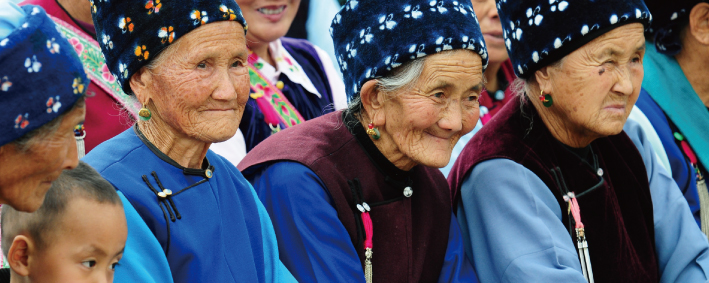
China transitioned from a diverse empire, fragmented and divided nation state, to a unitary single party socialist state with a constitution that recognizes itself as a multiethnic state. It has become a wealthy and powerful country in a technologically accelerated, interconnected, interdependent, multipolar and multicultural world. It’s ethnic minority population exceeds 110 million. Ethnic autonomous areas occupy 50% of the country and 90% of the borders with 16 other countries. The government officially recognizes 55 ethnic minority groups based on their cultural factors, including historical origin, mode of production, language, customs, religion, and a sense of solidarity. This course examines how China’s civilization, institutions, laws and policies address the challenges of multiethnic integration, including economic development, social equality, cultural autonomy, and national unity.
This course challenges students to answer a series of questions:
- What dominant interethnic identity processes are at work in China?
- Why is China multiethnic but not multicultural?
- How does China build a multiethnic community in a multicultural world?
- What laws and policies concern China’s ethnic minority groups?
- What is the main debate about whether ethnic minority rights are being protected?
- What are the pros and cons of preferential treatment policies for ethnic minorities?
- What are the domestic and international differences in views about Chinese ethnicity?
- Which ethnic theory is correct: Essentialism, instrumentalism, or constructivism?
- Which process is at work: assimilation, impact integration, or pluralism within unity?
- Does education in China prepare critical thinkers on ethnic identity in a civil society?
- What strategies lead members of ethnic groups to be effective citizens?
- What does Global AI do to cultural assimilation and cultural pluralism in China?
- Does AI in China help ethnic groups communicate and collaborate across cultural and national borders in ways that add value to the lives of our species?
- What role does artificial intelligence play in shaping cultural and national identity, ethnic representation and recognition, ethnicization and centralization, ethnocentrism and model minorities, ethnic and gender stratification, and empowerment?
- What does China learn from its heritage and from other multiethnic countries?
The course promotes the idea of cross-cultural communication as a way to bridge the differences between your own culture and the cultures of other ethnic groups locally, regionally, and globally. Finally, the course questions the meaning of multiculturalism as a Western idea, including its value for a world super-connector city like Hong Kong.
The course also presents an opportunity to students from different Schools, faculties and departments of the university to access knowledge about China’s ethnic groups as it related to their academic specialization. For example:
- Law: Laws, rights and protections.
- Arts: Ethnic music, art, dance, dress, (traditional and contemporary)
- Language: Heritage and preservation of ethnic languages and dialects.
- History: The source of Han ethnicity, empire diversity, and the civilizational state.
- Philosophy: Ethnic religious values that shape beliefs, practices, and cognition.
- Architecture: Structure and design of homes, religious building interiors.
- Engineering: Infrastructure to connect, protect and enrich ethnic communities.
- Business: Cultural trade and tourism, human resources, employment.
- Geography: Archaeological excavation, urbanization, sustainable development.
- Medicine and Dentistry: Tibetan medicine, medical customs, nutrition, health issues.
- Education: Intergenerational transmission of culture, educational access and equity, ethnic boarding schools, practical knowledge and skills.
Course Learning Outcomes
On completing the course, students will be able to:
- Know why Chinese mainland ethnicity is complex and why it shapes the culture and identity of China in the 21st Century.
- Compare the similarities and differences between ethnic groups in China and other multiethnic countries.
- Develop ideas and skills based on your conceptual understanding of the nature and processes of ethnicity in China and elsewhere in the world.
- Find ways to capitalize on the ethnic character of your own community, city, country, and region to navigate your current and future careers in a multicultural world of tech acceleration, interconnectivity, and interdependence.
Offer Semester and Day of Teaching
Second semester (Wed)
Study Load
| Activities | Number of hours |
| Lectures | 24 |
| Tutorials | 12 |
| Online course material | 20 |
| Reading / Self-study | 20 |
| Assessment: Debate presentation (incl preparation) | 20 |
| Assessment: Group presentation (incl preparation) | 20 |
| Assessment: In-class quizzes (incl preparation) | 20 |
| Total: | 136 |
Assessment: 100% coursework
| Assessment Tasks | Weighting |
| Group project and presentation | 20 |
| Interview | 20 |
| Debates | 20 |
| In-class writing exercises | 30 |
| Reflection writing | 5 |
| Tutorial participation | 5 |
| In-class quizzes | 0 |
Required Reading
Reading assignments average one hour per week. Excerpts of the following readings will be made available on Moodle:
- Chen, Y. -B. (2020). From “Lamb Kebabs” to “Shared Joy”: Cultural Appropriation, Ignorance and the Constrained Connectivity within the “One Belt, One Road” Initiative. Journal of Contemporary China, 29(121), 1-16.
- Ge, Z. (2018). What is China? Territory, ethnicity, culture, and history. Cambridge, Massachusetts: Harvard University Press. [pp. 134-148]
- Postiglione, G. (2009). Ethnic minorities in China. Berkshire encyclopedia of China. USA: Berkshire Publishing Company. [pp. 763-770]
- Postiglione, G. A. (2009). Dislocated education: The case of Tibet. Comparative Education Review, 53(4), 483-512.
- Postiglione. G.A. (2026) Higher Education in China: Domestic Demands and Global Aspirations, (Baltimore: Johns Hopkins University Press).
- Postiglione, G.A. (in press 2026) Higher Education and Geopolitics: China and the World, (London and New York: Routledge Press).
- Sun, Y. (2020). From Empire to Nation State: Ethnic Politics in China. Cambridge University Press. [Chap. 1 “What is destabilizing about China’s ethnic regions?” (pp. 1-24)]
- Wang, Gung Wu. (1991). The Chineseness of China. Oxford University Press. [pp. 1-7]
Course Co-ordinator and Teacher(s)
| Course Co-ordinator | Contact |
| Professor G.A. Postiglione Faculty of Education (Social Contexts and Policies of Education) |
Tel: 2859 2526 Email: gerry@hku.hk |
| Teacher(s) | Contact |
| Professor G.A. Postiglione Faculty of Education (Social Contexts and Policies of Education) |
Tel: 2859 2526 Email: gerry@hku.hk |